Crater Lake National Park
Crater Lake National Park
Nestled within the caldera of Mount Mazama, Crater Lake is North America's deepest lake. A practical guide to visiting this Oregon national park.
Crater Lake National Park, in southern Oregon, is home to North America's deepest lake, cradled within the caldera of an ancient volcano. Its 1,935-foot depth and saturated blue hue make it one of the most singular geological sites in the American West. The park welcomes hundreds of thousands of visitors each year, primarily between July and September.
Why Visit Crater Lake
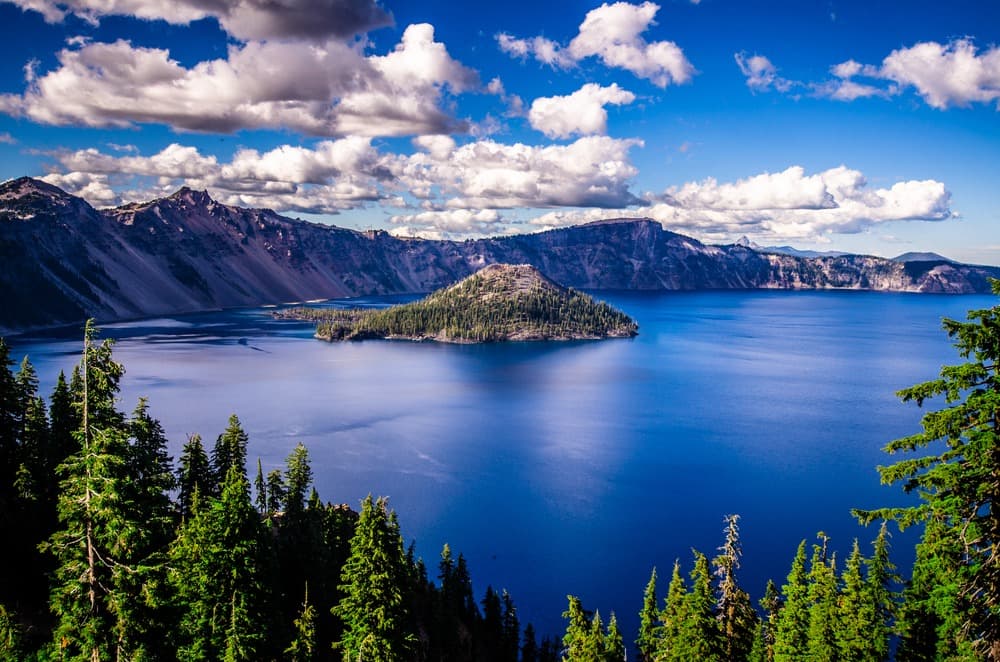
Crater Lake offers a rare combination: a high-altitude lake, situated between 3,970 and 6,960 feet, formed by the collapse of a volcano, with neither tributaries nor outlets. The water, fed solely by rainfall and snowmelt, possesses a purity that explains its intense blue color. The park suits both a quick driving visit (Rim Drive, scenic route) and days of hiking to surrounding peaks or by boat to Wizard Island.
Lovers of vast volcanic landscapes can continue to other Western sites like Bryce Canyon National Park or Canyonlands National Park, further southeast.
History and Formation of the Lake
A Caldera Born from a Major Eruption
Crater Lake occupies the caldera of Mount Mazama, a volcano whose massive eruption over 7,700 years ago triggered the collapse of its summit. The resulting basin gradually filled over centuries through precipitation and snowmelt, with no river input, a factor that contributes to the lake's present clarity.
A Klamath Legend
The Klamath tribe, present in the region for millennia, recounts a confrontation between Llao, spirit of the underworld, and Skell, spirit of the heights. Llao's defeat supposedly extinguished the fire of his realm, engulfed beneath the lake's waters. This oral tradition documents, in its own way, memory of the Mazama eruption.
From Deep Blue Lake to National Park
The first European to reach the lake was John Wesley Hillman, in 1853, who named it Deep Blue Lake. It would later be renamed Crater Lake. In the late 19th century, entrepreneur William Gladstone Steel led a lengthy campaign for its preservation, resulting in the creation of the national park in 1902.
What to See and Do
Rim Drive and Viewpoints
Rim Drive, a panoramic road of roughly 31 miles, circles the caldera (6.2 miles in diameter). It's the best way to grasp the scale of the site. Several overlooks punctuate the route:
- Sun Notch Viewpoint: plunging view of Phantom Ship.
- Discovery Point: commemorative landmark of the 1853 "discovery."
- Sinott Memorial Overlook: panorama and small interpretive museum.
- Watchman Overlook: one of the clearest angles on Wizard Island.
Along the way, you'll encounter local wildlife: ground squirrels and Clark's nutcrackers are most visible in forested areas and around parking areas.
Boat Tours, Wizard Island, and Phantom Ship
In season, boat excursions depart from Cleetwood Cove dock. They allow you to approach Phantom Ship — not a wreck but a volcanic rock formation whose silhouette resembles a sailing vessel — and to land on Wizard Island, the emergent volcanic cone. Swimming is permitted only on Wizard Island; it is prohibited elsewhere on the lake.
Hiking
- Castle Crest Wildflower Trail: easy loop through a wetland meadow rich in wildflowers, with no direct views of the caldera.
- Mount Scott: demanding ascent to 8,926 feet, the park's highest point, with sweeping views of the lake and the Cascade Range.
- Cleetwood Cove Trail: the only access to the lake's shore, short but steep on the return.
Practical Information
Accommodation
Two options within the park:
- Crater Lake Lodge: historic building from 1915 overlooking the caldera, book well in advance, high rates.
- Mazama Village Cabins: rustic cabins and camping located roughly 7 miles from the lake, more affordable.
Outside the park, the towns of Medford, Klamath Falls, and Bend offer a wider range of hotels.
Fees and Regulations
Park entry is charged per vehicle, with a permit valid for several days. Rates are revised regularly by the National Park Service; consult the official website before departure. The annual America the Beautiful pass is accepted.
When to Visit
The park experiences an alpine climate marked by heavy snowfall from October through June. The favorable season runs from July through September: roads are clear, trails are open, and boat excursions are operational. Nights remain cool even in peak summer — bring a fleece and windbreaker. In winter, the park remains accessible via the south entrance, but Rim Drive closes and activities are limited to snowshoeing and cross-country skiing.
How to Get There
Crater Lake lies roughly 233 miles south of Portland, or nearly 4 hours by car. A vehicle is essential: no public transportation serves the park.
- From Portland: I-5 south then Highway 138 or Highway 62.
- From Medford (regional airport): Highway 62 East to the south entrance, approximately 1.5 hours along the Rogue River.
- From Klamath Falls: roughly 1 hour via Highway 97 then the south entrance.
What to Combine in the Region
Crater Lake fits naturally into a broader itinerary in the American West. Within a day's drive, you'll find the Pacific coast of Oregon, the volcanic Cascades around Bend, and the Rogue River valley. To extend toward Utah and Arizona, sites like Bryce Canyon National Park round out the panorama of Western geological landscapes. Urban explorers can also encounter Cadillac Ranch along Route 66.
Frequently Asked Questions
Frequently asked questions
July through September. This is the only window when Rim Drive is fully open, trails are clear, and boats operate to Wizard Island. Outside this period, snow significantly limits access.
Swimming is permitted only on Wizard Island, accessible by boat from Cleetwood Cove. It is prohibited everywhere else on the lake. The water remains cold even in summer.
Allow a minimum of half a day to drive Rim Drive and visit its viewpoints, a full day if you add a hike or boat excursion, and two days to enjoy the park comfortably with an overnight stay.
Yes, the park remains open year-round via the south entrance, but Rim Drive closes with the first major snowfalls (often in October) and typically reopens in June or July. Winter is devoted to snowshoeing and cross-country skiing.
Plan Your Trip
Crater Lake fits naturally into a nature-focused itinerary in the American West, spanning Oregon, Northern California, and Nevada. To build a custom itinerary including the park and other major sites in the region, consult our États-Unis travel suggestions.
Interested in this visit?
We can include it in your personalised itinerary.